Measured effective compression
The article proposes moving beyond subjective judgment alone by measuring compression in Newton-meters at key points during bone transport.
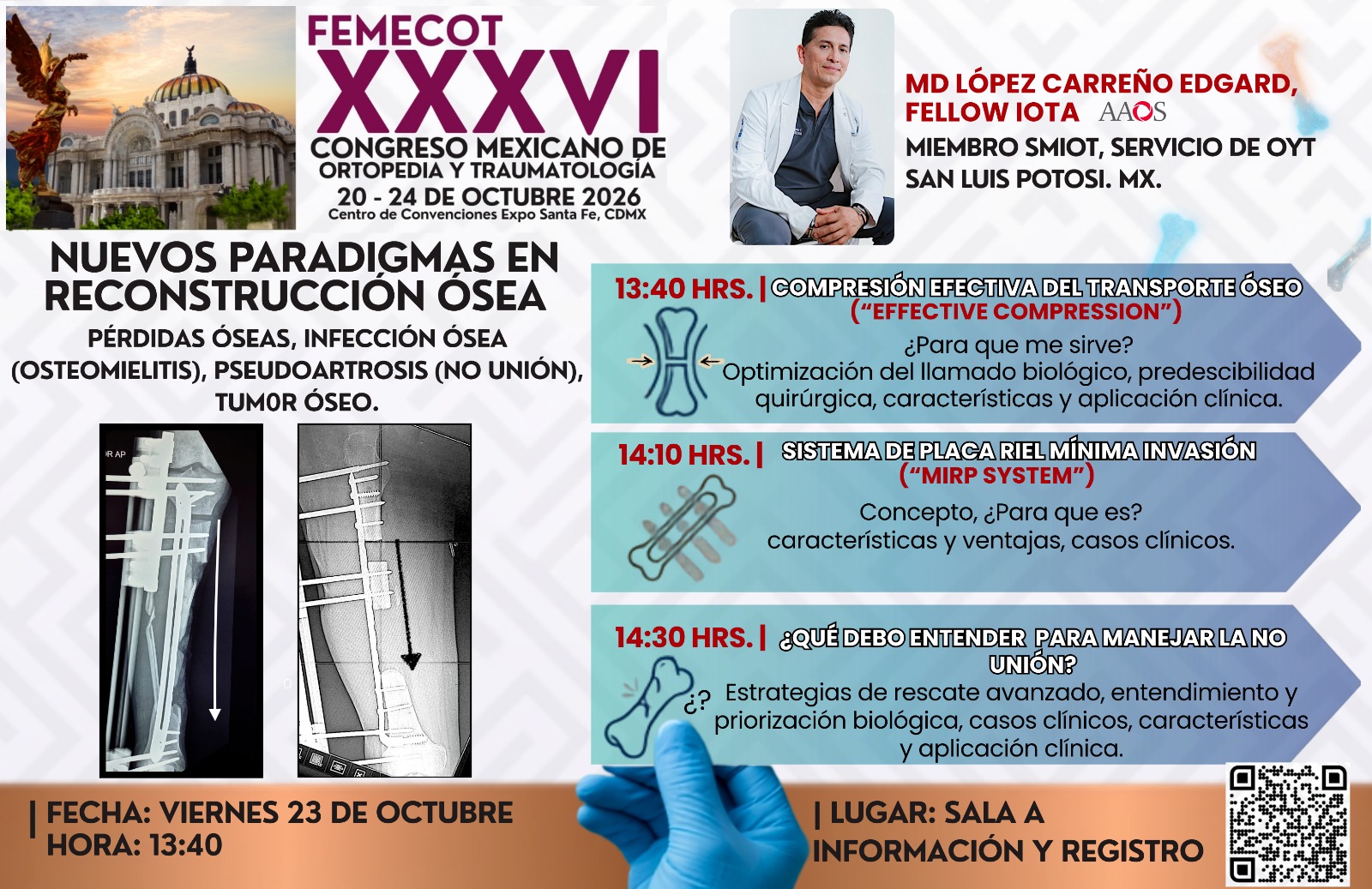
An alternative for restoring bone continuity, length, and alignment in complex cases of bone loss, infection, and nonunion. Dr. López Carreño’s approach integrates bone transport, objectively measured effective compression, and the minimally invasive rail plate MIRP to optimize the consolidation process.
Content based on the article "Effective Compression and a Minimally Invasive Rail Plate to Optimize Bone Transport in Distraction Osteogenesis", published in JBJS Open Access.
Distraction osteogenesis uses the bone’s ability to regenerate when it receives stability and gradual mechanical stimulus. Effective compression adds a measurable parameter to guide decisions during bone transport.
The article proposes moving beyond subjective judgment alone by measuring compression in Newton-meters at key points during bone transport.
Final compression helps support consolidation where the transported segment reaches its destination, always under adequate alignment and contact conditions.
The MIRP system works as a guide and stabilizer together with monolateral external fixation, maintaining orientation during transport.
The technique seeks to preserve tissues, respect bone biology, and support the regeneration process through each phase.
This video shows how the minimally invasive rail plate system integrates with bone transport to guide the segment, maintain orientation, and support docking site control during reconstruction.
In the study, the technique was applied in patients with pseudarthrosis, infection, and bone loss due to trauma or osteomyelitis. Evaluation must be individualized and performed by a specialist.
Reconstruction is organized by phases to control regenerate formation, segment transport, and final consolidation.
After osteotomy, initial compression is applied and measured to begin the mechanical environment for the regenerate.
The bone segment is gradually moved toward the defect, with radiographic follow-up and alignment control.
When the segment reaches the docking site, measurable final compression is applied to support consolidation.
The goal is to restore continuity, length, alignment, and function with rehabilitation indicated for each case.
The conference presents the foundations and clinical applications of effective compression in bone transport, the minimally invasive rail plate system, and advanced management of nonunion.
For patients, physicians, or institutions interested in bone reconstruction, bone transport, and effective compression, the next step is a specialist evaluation or a request for academic information.
The information on this page is educational. Diagnosis, surgical indication, and rehabilitation planning must be defined during a medical consultation.
The conference invitation remains at the top with the registration QR code. For academic questions or specialist evaluation, use the contact email.